

A Practical Guide to Getting Exactly What You Want
Introduction
I wrote a full guide on prompting Claude, and it forced me to realize something: different models reward different thinking.
ChatGPT isn’t just “another AI chatbot.” It behaves differently. It responds differently. And if you prompt it the same way you prompt Claude, you’ll leave a lot of value on the table.
This guide breaks down how ChatGPT actually works, what it’s best at, and how to structure prompts that consistently produce high-quality results.
What ChatGPT Is Actually Good At
Most people use ChatGPT like a search engine. That’s the lowest-leverage use case.
ChatGPT excels at:
- Structured thinking and breakdowns
- Iteration and refinement
- Writing + rewriting in different styles
- Code generation and debugging
- Turning vague ideas into concrete outputs
- Multi-step reasoning when guided properly
It is not “thinking.” It is predicting text based on patterns learned from massive datasets. That single fact explains almost everything about how to prompt it.
How ChatGPT Works (A Simple Explanation)
At its core:
- It uses a transformer-based neural network to process language [Techtarget]
- It was trained on large amounts of text and code
- It predicts the next most likely word based on your prompt
- It improves responses using human feedback (RLHF) [Coursera]
The key implication is that ChatGPT does not understand your intent. It approximates it. This means your prompt is not a question. It’s programming input.
The Core Prompting Framework (Use This Every Time)
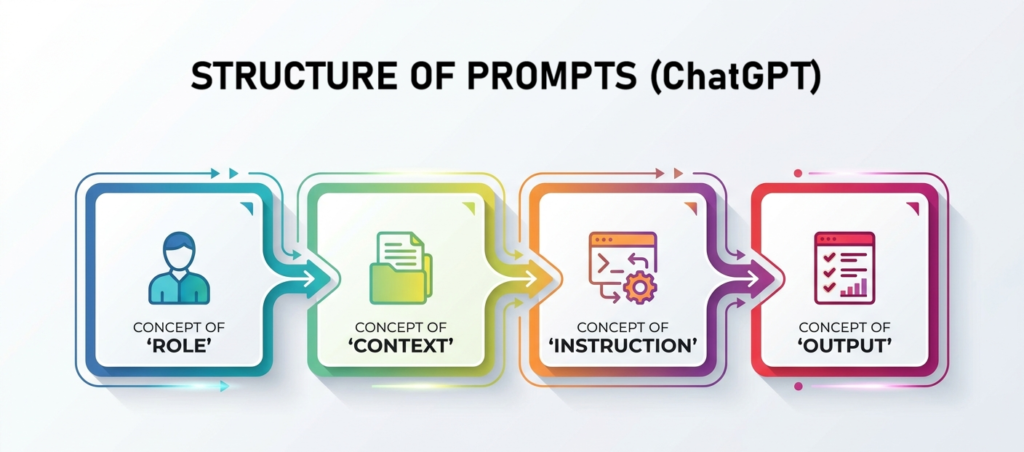
Every strong prompt has 4 parts:
1. Role – Who ChatGPT should act as
2. Context – Background information
3. Instruction – What you want done
4. Output Format – How the answer should look
This structure aligns with how LLMs respond best to clear, structured input [Liminfo] .
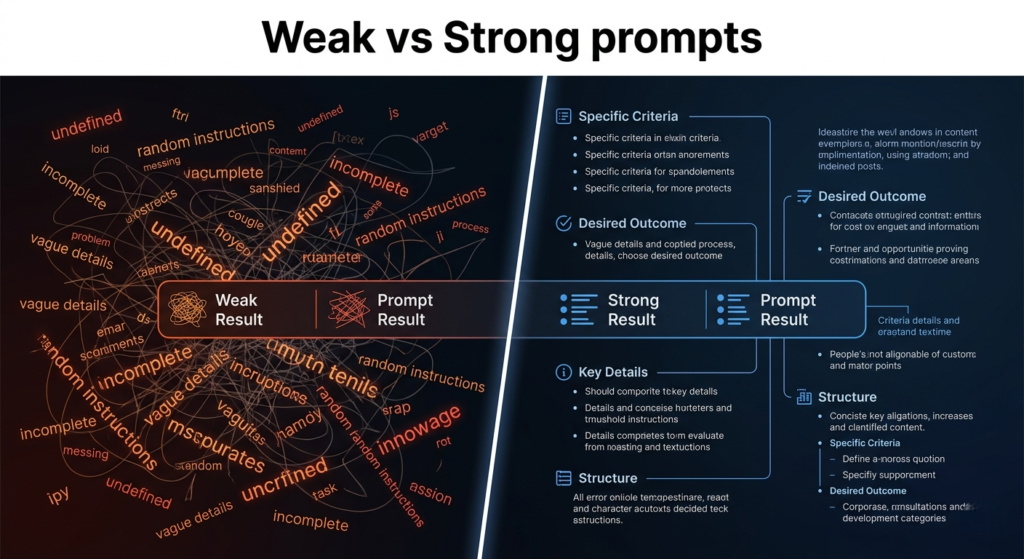
Example (Weak vs Strong)
Weak prompt:
“Give me marketing ideas”
Strong prompt:
“Act as a digital marketing strategist. I run a small e-commerce brand selling minimalist home decor. Give me 5 customer acquisition strategies under $500/month. Present as bullet points with expected ROI.”
The difference is precision.
The 6 Prompting Principles That Actually Matter
1. Specificity Beats Intelligence
Vague prompts = generic output.
Adding constraints and context improves accuracy significantly [Techtarget]
2. Treat It Like a System, Not a Person
Don’t “chat.” Structure.
Bad:
“Hey, can you maybe help me write something?”
Good:
“Write a 500-word blog post in a conversational tone for beginners about intermittent fasting.”
3. Break Complex Tasks Into Steps
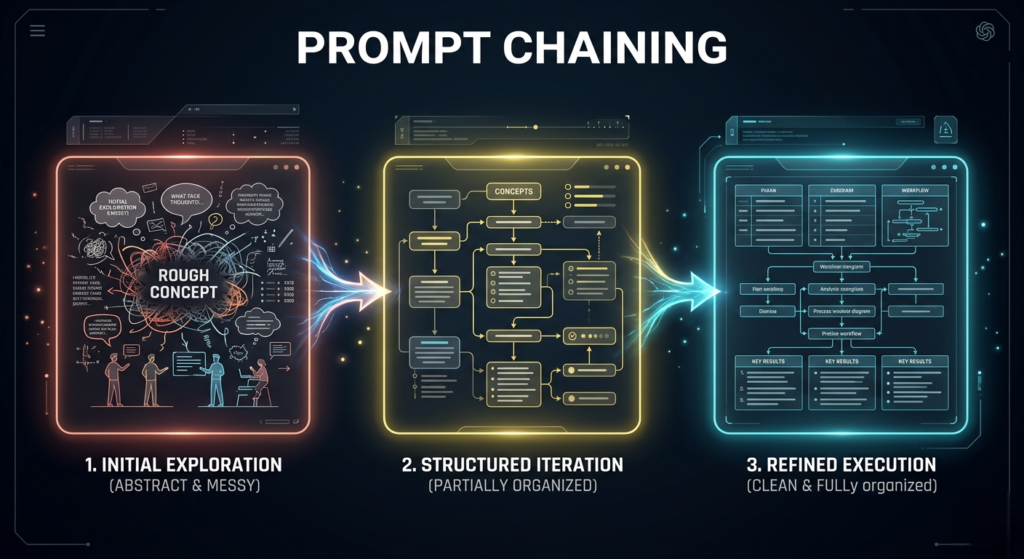
ChatGPT performs better when tasks are decomposed.
This is called prompt chaining .
4. Show Examples (Few-Shot Prompting)
If you want a specific style or format, show it.
You are training the output in real time.
5. Control the Output Format
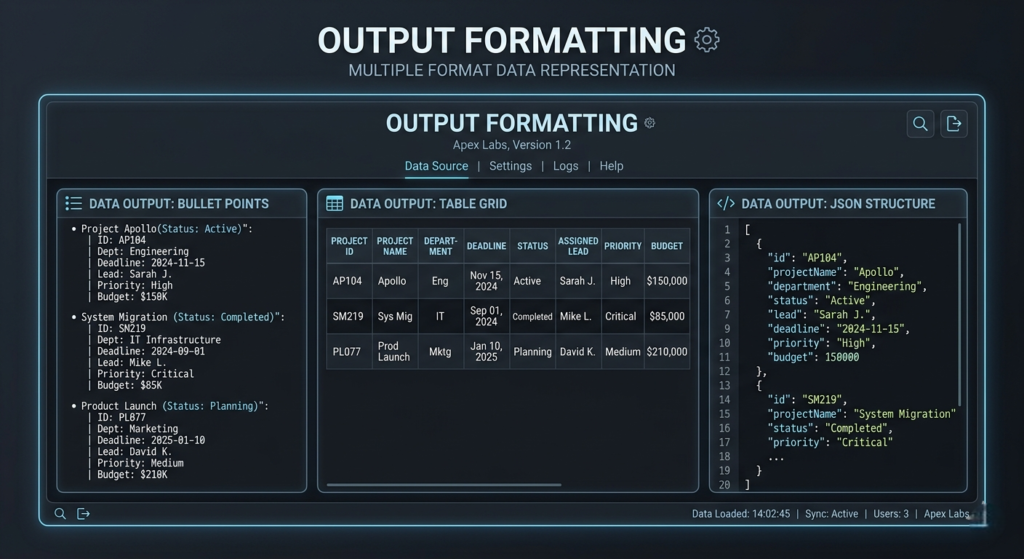
If you don’t define structure, you get randomness.
Examples:
- “Return as JSON”
- “Use bullet points”
- “Write in table format”
6. Iterate, Don’t Restart
ChatGPT improves with follow-ups because it retains context within the conversation window
High-Performance Prompt Scripts
These are reusable.
1. The “Do Exactly This” Script
Act as a [ROLE].

Context:
[BACKGROUND INFO]

Task:
[EXACT INSTRUCTION]

Constraints:
- [Constraint 1]
- [Constraint 2]

Output format:
[Specify structure]
2. The “Improve This” Script
Improve the following content for clarity, engagement, and structure.

Content:
[PASTE]

Constraints:
- Keep original meaning
- Make it more compelling
- Remove fluff
3. The “Expert Breakdown” Script
Explain [TOPIC] like an expert teaching a beginner.

Break it down into:
1. Simple explanation
2. Real-world analogy
3. Key concepts
4. Common mistakes
4. The “Content Generator” Script
Act as a professional content writer.

Write a [TYPE OF CONTENT] about [TOPIC].

Target audience: [AUDIENCE]

Tone: [TONE]

Include:
- Hook
- Main points
- Conclusion
5. The “Meta Prompt” Script (Advanced)
I want to achieve: [GOAL]

Write the best possible prompt I should use to get that result from ChatGPT.
What ChatGPT Does Better
Based on behavior patterns:
- Image Generation
- Creative Writing
- Better step-by-step reasoning when guided
That changes how you prompt.
Common Mistakes
- Treating it like Google
- Not specifying output format
- Asking too many things in one prompt
- Not iterating
- Overloading with unnecessary detail
Featured Image Concept
Visual concept:
- A human typing into a glowing interface
- Words transforming into structured blocks (code, lists, diagrams)
- Subtle neural network patterns in the background
- Contrast between “messy prompt → clean output”
Tone: futuristic, minimal, intelligent
Supporting Images Inside the Article
1. Prompt Structure Diagram
- Visual of: Role → Context → Instruction → Output
- Clean flow diagram
2. Weak vs Strong Prompt Comparison
- Side-by-side example
- Highlight differences in output quality
3. Prompt Chaining Flow
- Step 1 → Step 2 → Step 3 progression
- Shows refinement process
4. Output Formatting Examples
- Same prompt, different formats (bullets, table, JSON)
Closing Insight
Prompting ChatGPT is not about asking better questions. It’s about giving better instructions. Once that clicks, the model stops feeling random and starts feeling precise. Precision replaces guesswork. ChatGPT stops behaving like an unpredictable chatbot and starts operating like a controlled system the moment inputs become structured, constrained, and intentional. The advantage does not come from asking better questions; it comes from designing better instructions. Once that shift is internalized, output quality scales with clarity, and the model becomes a reliable extension of structured thinking rather than a source of randomness.
Looking for tips and tricks on prompting Claude AI? Click here.
Vikram Udyawar is a marketer with a passion for all things AI. He writes about the ideas and experiences that shape how he thinks.