

Why the real risk isn’t artificial intelligence — it’s intellectual passivity
Quick Answer (TL;DR)
Does AI make you smarter or dumber? The research suggests both are possible — and the determining factor is how you engage with it. Passive use (letting AI do your thinking for you) is associated with reduced brain activity and weakened memory. Active use (using AI as a thinking partner that challenges and sharpens your reasoning) is associated with stronger arguments, greater creativity, and better outcomes. The tool is neutral. The mindset is everything.
Reading time: 7 minutes
There is a question that keeps surfacing in offices, universities, and opinion columns around the world, and it goes something like this: are we outsourcing our brains?
It is a fair question. If AI can write your report, summarise your research, draft your emails, and answer your questions faster than you can form them — what exactly are you left to do? And more unsettling: what happens to your ability to think independently when you stop practising it?
The anxiety is understandable. But the framing is wrong.
The question is not whether AI makes you smarter or dumber. The question is whether you are using it as a crutch or as a sparring partner. The answer to that question makes all the difference.
What the Research Actually Says (It Is More Nuanced Than the Headlines)
The Case for Concern: What Passive AI Use Does to Your Brain
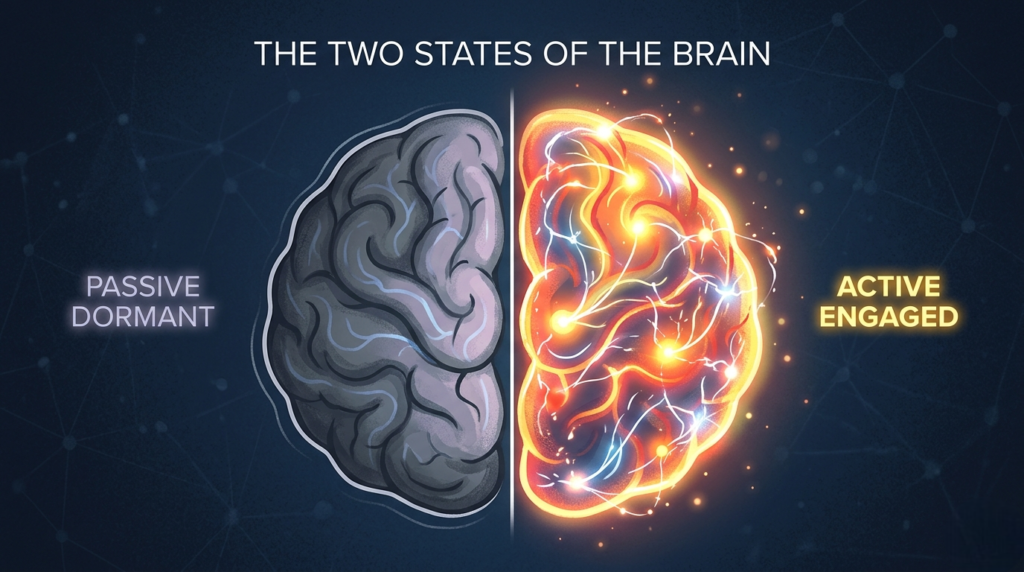
In June 2025, MIT Media Lab researchers published a study titled “Your Brain on ChatGPT,” and it generated the kind of headlines that make people nervous about the technology they use every day.
The research tracked brain activity across four writing sessions in 54 students, dividing them into three groups: those who wrote with no tools, those who used Google for research, and those who used ChatGPT. Researchers attached EEG headsets to monitor neural engagement throughout. EdTech Innovation Hub
The results were striking. Students using ChatGPT showed lower brain activity, weaker memory recall, and less ownership of their writing. Their essays were well-structured and grammatically polished — but they learned and retained less. Risepoint
ChatGPT users also had the lowest brain engagement of the three groups, and grew lazier with each subsequent essay, often resorting to copy-and-paste by the end of the study. The group that used ChatGPT delivered essays that were extremely similar to each other — lacking original thought and relying on the same expressions and ideas. Time
It is important to note the study’s own caveats. It is a preprint draft that has not yet been peer-reviewed, and the authors themselves caution that all conclusions should be treated as preliminary. They explicitly asked that words like “brain damage,” “collapse,” and “harm” not be used to describe the findings. The sample size was small, and the context — students writing SAT-level essays — is specific. Transparencycoalition
But the direction of the finding is real, and it echoes something cognitive scientists have observed before. Research on GPS trackers suggests that when we rely too heavily on automated navigation, our spatial memory declines. Studies on pilots show that those who rely on autopilot lose critical situational awareness skills. We have seen this pattern with every technology that takes over a task we used to do ourselves. Techxplore
The risk has a name: cognitive offloading. And a 2025 study published in the journal Societies, drawing on surveys and interviews with 666 participants across diverse age groups, found a significant negative correlation between frequent AI tool usage and critical thinking abilities, with younger participants showing higher dependence on AI and lower critical thinking scores compared to older participants. MDPI
The Case for Optimism: What Active AI Use Does to Your Thinking
Here is where the story gets more interesting — and more hopeful.
The MIT study did not only find that AI reduces cognitive engagement. It also found something that got far less coverage. When the brain-only group was permitted to rewrite their essay with access to ChatGPT, their efforts showed higher levels of creativity and stronger arguments, while retaining original thinking and unique language. Psychology Today
In other words: people who had already done the hard cognitive work themselves, and then brought in AI, got the best of both worlds.
This is not a coincidence. It reflects a broader pattern in the research. Adult learners who engaged with generative AI tools and knew how to use them well reported better critical thinking abilities — because competent AI use encourages users to question, analyse, and improve AI-generated content rather than simply accept it. Nature
AI also excels at generating thought-provoking questions, counterarguments, and debate prompts that learners can critically evaluate and refine — driving analysis beyond surface-level responses. When used this way, AI does not replace your thinking. It stress-tests it. Western Michigan University
The Sparring Partner Model: A Better Way to Think About AI
There is a concept in software development called rubber duck debugging. When a programmer is stuck on a problem, they explain it out loud — step by step — to a rubber duck sitting on their desk. The duck says nothing. But the act of articulating the problem precisely enough to explain it to something else often reveals the flaw in the logic that the programmer couldn’t see when the thinking was all internal.
AI is creating this same effect for problem-solving more broadly — making us better thinkers by making us better explainers. The shift encourages more deliberate, more explicit, more precise reasoning. The difference from a rubber duck, of course, is that AI talks back. It asks clarifying questions. It surfaces assumptions you did not know you were making. It offers an alternative perspective you had not considered. Substack
Used this way, AI is not a shortcut around thinking. It is a magnifier of it.
This is the distinction that most coverage of AI and cognition misses entirely. The question is not “does AI think for you?” — the question is “what are you doing while AI is involved?” If the answer is nothing, the concern is legitimate. If the answer is engaging, questioning, pushing back, and building on what AI produces — the outcome looks very different.
The Two Modes of AI Use (and Why One Builds You Up While the Other Doesn’t)
It helps to think of AI use as falling into one of two modes.
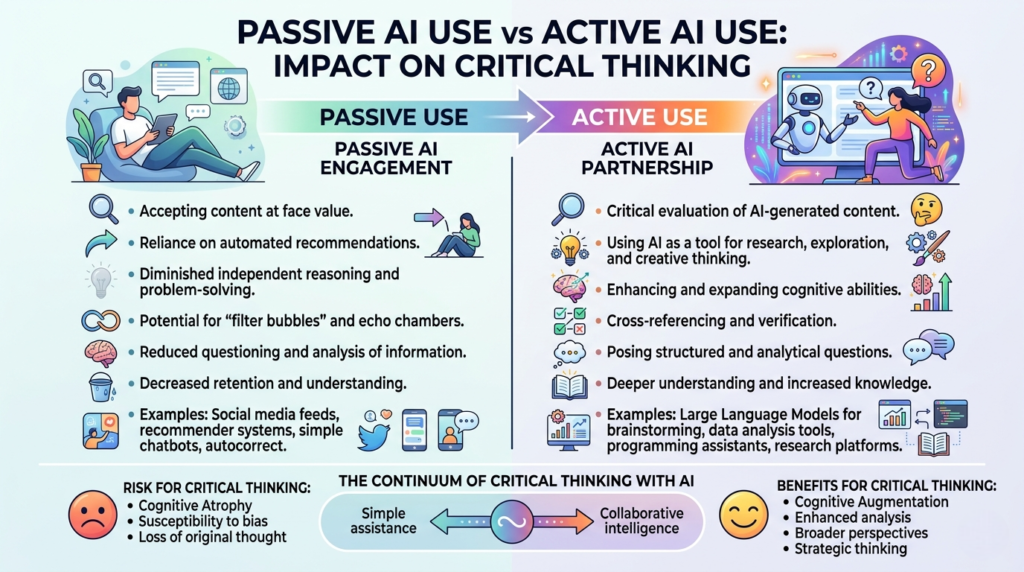
Passive mode is when you hand a problem to AI and accept what comes back. You paste a document in, read the summary, and move on. You ask for a draft, copy it, and send it. The task is done. Your brain was barely involved. This is the mode the MIT study was measuring — and the mode that correlates with reduced cognitive engagement over time.
Active mode is when you use AI as a thinking partner rather than a task-completer. You bring your own thinking first. You use AI to pressure-test it, challenge it, or extend it. You evaluate what AI produces critically, push back when something doesn’t seem right, and integrate the output with your own judgement. Research suggests that AI systems can support metacognitive reflection and critical thinking when integrated thoughtfully — it is the passive, over-reliant mode that fosters passivity and procrastination. arxiv
The practical difference looks like this:
Passive: “Write me a strategy for growing my LinkedIn following.”
Active: “Here is my current thinking on growing my LinkedIn following. What am I missing? What would you push back on? What assumptions am I making that might not hold up?”
Same tool. Completely different cognitive experience.
What This Means for How You Should Use AI at Work
The implication is not to use AI less. It is to use it more intentionally.
A few practical principles that follow from the research:
Think first, then prompt. Before you ask AI to produce anything, spend five minutes writing down your own initial thinking. Even a rough, messy set of notes is enough. This primes your brain, gives AI better material to work with, and ensures you remain the author of the thinking — not just the editor of AI’s output.
Ask AI to challenge you, not just help you. Instead of asking for answers, ask for objections. “What are the weakest points in this argument?” “What am I not considering?” “What would someone who disagreed with this say?” This is where AI becomes genuinely useful for sharpening ideas rather than simply producing them.
Evaluate before you accept. Treat AI output the way you would treat the first draft from a smart but fallible colleague. Read it critically. Notice what feels right and what doesn’t. Push back. The friction of evaluation is where the cognitive benefit lives.
Use AI to go deeper, not to skip the surface. If AI summarises a complex topic for you, use that summary as a starting point for further exploration — not as a destination. The summary is a map. The thinking is the territory.
If you want to build these habits with Claude specifically, the guide to prompting Claude.ai effectively covers the exact techniques that put you in control of the conversation rather than the other way around. And for a broader view of how to integrate AI into your working life without disrupting what already works, the piece on why small, incremental AI wins outperform big transformation projects is a useful companion read.

The Deeper Point Nobody Is Talking About
Every major cognitive technology in history has attracted the same fear. Writing, it was argued by Socrates, would weaken memory because people would no longer need to hold information in their heads. The calculator would make people incapable of arithmetic. Search engines would make us intellectually shallow.
Each of these concerns had some truth to it. Writing did change how memory works. Calculators did change what mental arithmetic skills we cultivate. Search engines did change our relationship with stored knowledge.
But in each case, something else happened too. The cognitive energy that was freed up did not simply evaporate. It moved. It was redirected toward more complex problems, more sophisticated questions, higher-order thinking that the previous generation simply did not have the bandwidth to pursue.
The people who thrived in each transition were not the ones who refused the new tool or the ones who surrendered to it entirely. They were the ones who learned to use it deliberately — preserving the thinking that made them effective while offloading the tasks that did not require their full attention.
AI is no different. The risk is real. So is the opportunity. Which one you encounter depends almost entirely on which mode you choose to operate in.
Common Questions About AI and Critical Thinking
Q: Does using AI make you less intelligent over time? The honest answer is: it depends on how you use it. Passive use — letting AI do the thinking and simply accepting the output — is associated with reduced cognitive engagement and weaker memory retention, based on current research. Active use, where you bring your own thinking first and use AI to challenge and extend it, appears to support stronger reasoning and creativity.
Q: What is cognitive offloading, and should I be worried about it? Cognitive offloading is the process of transferring mental tasks to an external tool — whether that’s a calendar, a calculator, or an AI. It is not inherently harmful; humans have always used tools to extend their cognitive capacity. The concern arises when offloading replaces the cognitive work that builds skills and understanding, rather than simply handling tasks that don’t require deep engagement.
Q: Is it bad to use AI to write emails, reports, or other work documents? Not necessarily. The key is whether you are engaging with the output critically or simply passing it along. Using AI to draft something and then editing it thoughtfully — checking the logic, the tone, the accuracy — keeps you cognitively in the loop. Using AI to produce something you never really read is where quality and cognition both suffer.
Q: What did the MIT “Your Brain on ChatGPT” study actually conclude? The study found that students who used ChatGPT from the outset showed lower brain activity, weaker memory retention, and less creative diversity in their writing compared to students who wrote unaided or used search engines. Importantly, the study also found that students who had written unaided first and were then given AI access produced their strongest, most creative work. The study is a preprint and has not yet been peer-reviewed, so its findings should be treated as preliminary.
Q: How do I use AI as a thinking partner rather than a crutch? Start by doing your own thinking before you involve AI. Write down your initial ideas, even roughly. Then use AI to challenge those ideas rather than replace them — ask for objections, counterarguments, and blind spots. Evaluate the output critically before accepting it. The goal is to remain the author of the thinking, with AI as a rigorous and well-informed editor.
References & Sources
1. MIT Media Lab — “Your Brain on ChatGPT” (June 2025) The central study cited throughout the article. A preprint (not yet peer-reviewed at time of writing) tracking EEG brain activity across 54 participants writing essays with ChatGPT, Google, or no tools.
Full citation: Kosmyna, N., Hauptmann, E., Yuan, Y.T., Situ, J., Liao, X.H., Beresnitzky, A.V., Braunstein, I., & Maes, P. (2025). Your Brain on ChatGPT: Accumulation of Cognitive Debt when Using an AI Assistant for Essay Writing Task. arXiv preprint arXiv:2506.08872.
Direct link: https://www.media.mit.edu/publications/your-brain-on-chatgpt/ Project overview: https://www.media.mit.edu/projects/your-brain-on-chatgpt/overview/
Note: the MIT study is a preprint and had not completed peer review at time of writing
2. MDPI Societies — AI Tools and Critical Thinking (January 2025) The peer-reviewed study of 666 participants finding a significant negative correlation between frequent AI tool usage and critical thinking abilities, mediated by cognitive offloading.
Full citation: AI Tools in Society: Impacts on Cognitive Offloading and the Future of Critical Thinking. Societies, 15(1), 6. https://doi.org/10.3390/soc15010006
Direct link: https://www.mdpi.com/2075-4698/15/1/6
3. Scientific Reports / Nature — GenAI Competence and Critical Thinking (October 2025) The source for the finding that adult learners who engaged with generative AI tools and used them competently reported stronger critical thinking abilities.
Full citation: The chain mediating role of critical thinking and AI self-efficacy in GenAI usage competence and engineering students’ creativity. Scientific Reports (2025). https://doi.org/10.1038/s41598-025-21132-0
Direct link: https://www.nature.com/articles/s41598-025-21132-0
4. University of Melbourne / Pursuit — “As AI Gets Smarter, Are We Getting Dumber?” (February 2025) Source for the GPS spatial memory and pilot autopilot examples used in the cognitive offloading section.
Author: Associate Professor Grant Blashki, Nossal Institute for Global Health, University of Melbourne.
Direct link: https://pursuit.unimelb.edu.au/articles/as-ai-gets-smarter,-are-we-getting-dumber
5. Psychology Today — “Is AI Making Us Stupider?” (July 2025) Secondary source covering the MIT study findings, including the key detail that brain-only participants who were then given ChatGPT access produced their strongest, most creative work.
6. Western Michigan University — AI and Critical Thinking in Education Source for the finding that AI excels at generating counterarguments and debate prompts that drive analysis beyond surface-level responses.
Direct link: https://wmich.edu/x/teaching-learning/teaching-resources/ai-critical-thinking
7. arXiv — Efficiency Without Cognitive Change (2024) The academic source for the nuanced finding that AI can support metacognitive reflection when used thoughtfully, while passive reliance fosters procrastination and reduced initiative.
Direct link: https://arxiv.org/pdf/2510.24893