

Introduction: The prompt is not the workflow
Artificial intelligence has changed the way we approach work. Tasks that once required hours of research, writing, analysis, or creative exploration can now be started in a matter of minutes.
With the right prompt, an AI model can generate a marketing strategy, summarize a lengthy document, brainstorm campaign ideas, write code, or produce an image from a simple description. The possibilities are extensive, and the technology continues to evolve.
But there is a distinction that often gets overlooked: knowing how to prompt an AI tool is not the same as knowing how to build an effective AI workflow.
A well-written prompt can produce an impressive response. A well-designed workflow can help you consistently produce useful work.
That difference matters in professional environments, particularly in marketing, where success depends on more than generating content. Teams need to understand their audience, maintain brand consistency, coordinate across departments, manage data, meet deadlines, and evaluate whether their work is achieving its intended purpose.
AI can support many of these activities. However, its value depends on how it is integrated into the broader process.
The goal should not be to automate every task or replace human judgment with machine-generated output. The goal should be to create a system where AI handles appropriate work, people provide context and oversight, and the combined process produces better results.

The value of AI comes from designing a repeatable workflow
1. Start with the problem, not the technology
One of the most common mistakes organizations make when adopting AI is beginning with the tool rather than the problem.
A new AI platform becomes available, and the immediate question is, “What can we use this for?”
That approach can lead to experimentation, but it doesn’t always lead to meaningful improvements. Teams may generate large amounts of content, automate steps that weren’t particularly time-consuming, or introduce additional review work without addressing the underlying challenge.
A more useful starting point is to identify a specific problem.
Where is the team losing time? Which tasks are repetitive? Where do errors occur? Which processes depend too heavily on manual work? What information is difficult to organize or access?
For example, a marketing team might spend several hours preparing the initial draft of a campaign brief. AI could help organize the information, identify missing details, suggest a structure, and generate a preliminary draft.
The purpose isn’t simply to produce the brief faster. It is to free up time for the work that requires more strategic thinking: clarifying the objective, understanding the audience, reviewing the messaging, and aligning stakeholders.
The distinction is important because efficiency is only valuable when it contributes to a meaningful outcome.
A workflow that saves 30 minutes but creates additional errors or review requirements may not be an improvement. A workflow that reduces repetitive work while maintaining quality and accountability is more likely to deliver lasting value.
2. Break the work into stages
AI becomes easier to manage when a complex task is divided into smaller, clearly defined stages.
Instead of asking an AI tool to “create a complete marketing campaign,” consider separating the process into a series of steps:
AI-assisted campaign workflow
Example
- Research: Collect relevant information about the audience, market, product, and campaign objective.
- Strategy: Define the campaign’s purpose, positioning, key message, and intended audience.
- Development: Generate potential concepts, messaging variations, content outlines, and creative directions.
- Review: Check factual accuracy, strategic alignment, tone, brand requirements, and compliance.
- Execution: Adapt the approved material for the appropriate channels and complete the required production steps.
- Measurement – Review performance data and document what can be improved in future campaigns.
Each stage has a different purpose, and the appropriate role for AI may vary.
AI might be useful for organizing research or developing initial creative concepts. Strategic decisions, approvals, and quality control may require substantial human involvement.
Breaking the process into stages also makes it easier to identify where something went wrong. If a campaign contains an inaccurate claim, for example, the team can review the research and approval stages instead of treating the entire workflow as an unexplained failure.
This is particularly useful in marketing operations, where repeatability and accountability matter as much as speed.
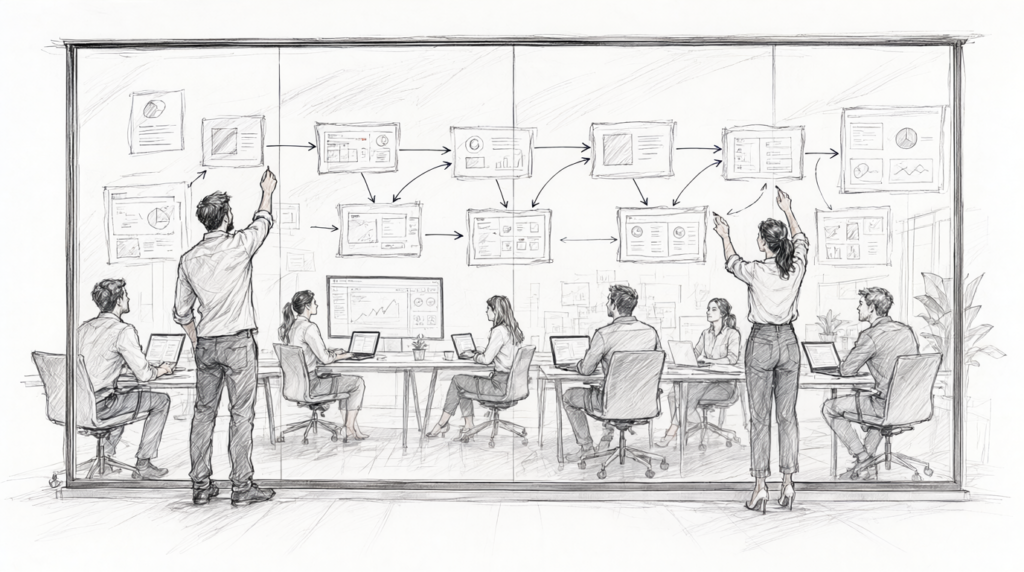
A practical example from my own work illustrates how this approach can turn a technical solution into a repeatable marketing operations workflow. Rather than using AI or automation as an isolated experiment, I connected data retrieval, storage, and reporting to solve a recurring attribution challenge.
Real-World Example: Turning UTM Data Into a Marketing Intelligence Workflow
One practical example of applying this approach is a marketing attribution workflow I developed to improve how our team captures, organizes, and analyzes UTM parameters across multiple websites.
Previously, UTM data captured through form submissions could be difficult to consolidate and analyze consistently. To address this, I built a script that connects to an MCP (Model Context Protocol) server for a UTM management tool. The script retrieves UTM values captured through form submissions and adds them to a centralized database. The data collected is limited to UTM parameters and related attribution information, with no personally identifiable information (PII) or protected health information (PHI) included.
I then developed a dashboard that reads from this database and provides a practical view of campaign attribution activity. The dashboard allows the team to:
- View snapshots of UTM values captured over the previous three months.
- Select custom date ranges to investigate specific campaigns or periods.
- Compare UTM activity across multiple websites.
- Identify trends in campaign tracking and marketing source data.
- Access consolidated attribution information without manually compiling reports from separate sources.
From a Script to a Repeatable Workflow
The script itself is only one part of the solution. The real value comes from connecting the data collection process, database, and reporting dashboard into a repeatable workflow.
The process follows a series of connected stages:
- Data capture: UTM parameters are collected through form submissions.
- Data retrieval: The script connects to the UTM tool through MCP.
- Data storage: Relevant UTM values are added to a centralized database without PII or PHI.
- Data visualization: The dashboard reads from the database and presents the information in an accessible format.
- Analysis: Marketing teams can review trends, compare websites, and investigate custom reporting periods.
This approach demonstrates an important distinction in AI and automation projects: the goal is not simply to create a script that performs a task. The goal is to build a workflow that makes useful information more accessible, reduces repetitive manual work, and supports better decision-making.
The Value for the Team and Organization
For the marketing team, this workflow reduces the effort required to gather and organize UTM data. Instead of repeatedly extracting information from different websites or tools and manually assembling snapshots, team members can use a centralized dashboard to access the information they need.
It also creates greater consistency in how attribution data is reviewed. The ability to compare multiple websites and define custom date ranges makes it easier to investigate campaign activity, identify changes over time, and support reporting requests.
At the organizational level, the workflow provides a more scalable foundation for marketing measurement. Centralizing UTM data helps create a shared view of campaign tracking across digital properties, while the dashboard makes that information easier to use in operational and strategic discussions.
The benefits include:
- Improved efficiency: Less manual effort spent gathering and preparing UTM reports.
- Greater visibility: A consolidated view of attribution data across multiple websites.
- Faster analysis: Custom date ranges and comparison capabilities support quicker investigations.
- Better consistency: A repeatable process reduces reliance on individually maintained spreadsheets and manual reporting methods.
- Scalability: The database and dashboard provide a foundation that can be expanded as tracking requirements evolve.
- Privacy-conscious design: The workflow focuses on UTM and attribution data without including PII or PHI.
The most important lesson is that the value did not come from MCP, the script, or the dashboard individually. It came from combining them into a connected system that addresses a specific operational challenge. The technology enabled the workflow, but the workflow design created the business value.
3. Context is more valuable than complexity
A prompt can be long without being useful.
Adding more instructions, descriptive language, or complicated formatting does not automatically improve the quality of an AI response. What matters is whether the model has the information needed to perform the task effectively.
Context helps define the boundaries of the work.
Consider the difference between these two prompts:
Basic prompt:
Write a marketing email for a mental health service.
Context-rich prompt:
Write a professional email for an audience researching mental health support in Canada. The objective is to explain the service clearly and encourage the reader to explore available options. Use empathetic, accessible language, avoid making unsupported clinical claims, and provide a concise subject line and body copy. The messaging should be appropriate for a professional healthcare-related organization.
The second prompt provides more direction around the audience, objective, tone, and constraints. It still requires review, but it gives the AI a more defined task.
Useful context may include:
- The intended audience.
- The business objective.
- The communication channel.
- Brand voice and messaging guidelines.
- Relevant source material.
- Output format.
- Regulatory, privacy, or legal considerations.
- Examples of acceptable and unacceptable output.
In practice, the best workflows often combine reusable instructions with task-specific information. A brand’s writing guidelines can be maintained as a reference, while each individual request provides the campaign objective, audience, and relevant details.
This reduces the need to repeat the same requirements in every prompt and can help improve consistency across projects.
However, context should be managed carefully. Sensitive information, confidential business data, and personal information should not be entered into an AI tool without appropriate authorization and safeguards. Organizations should understand how their chosen tools handle data, retention, and access.
4. Human judgment remains part of the system
The phrase “human in the loop” can sound like a technical concept, but the underlying idea is straightforward: people remain responsible for reviewing and guiding AI-assisted work.
This is especially important when the output affects customers, business decisions, or public communication.
AI-generated content can be plausible without being accurate. It may misinterpret instructions, invent details, overlook important context, or produce language that doesn’t fit the intended audience.
A review process should therefore be designed around the type of work being produced.
For a marketing article, the review may include:
- Accuracy: Are the claims supported by reliable information?
- Relevance: Does the content address the intended audience’s needs?
- Strategic alignment: Does it support the business objective?
- Brand consistency: Is the tone appropriate and consistent with the organization’s guidelines?
- Risk and compliance: Are there privacy, legal, or industry-specific concerns?
- Editorial quality: Is the writing clear, useful, and free of unnecessary repetition?
The level of review should match the risk and importance of the task. A brainstorming session for internal ideas may require a different process from publishing healthcare-related information or sending a customer-facing campaign.
The key is to avoid treating AI output as automatically ready for use.
AI can accelerate the creation of a first draft. It does not eliminate the need for someone to take responsibility for the final result.

5. Design for repeatability, not one-time success
A workflow that produces a good result once is not necessarily a successful workflow.
In a professional environment, the bigger question is whether the process can be repeated without depending entirely on one person’s memory, individual prompting style, or last-minute improvisation.
Repeatability requires some level of documentation and standardization.
For a marketing team, this might include a shared prompt library, campaign briefing template, content review checklist, or documented process for using AI in specific tasks.
For example, a content production workflow could include:
- A standardized campaign brief.
- A defined set of brand and audience guidelines.
- Approved source material.
- A series of prompts for research, outlining, and drafting.
- A review checklist.
- A clear approval process.
- A record of the final output and any significant revisions.
The goal is not to make every task rigid. Creative work needs room for experimentation, and different projects may require different approaches.
Instead, standardize the parts of the process that benefit from consistency while preserving flexibility where human judgment and creative exploration are essential.
This is where AI adoption intersects with operations. The technology is only one component. The workflow also needs ownership, documentation, appropriate access, and a clear understanding of how the output moves from one stage to the next.
6. Measure whether the workflow is actually improving work
If the purpose of adopting AI is to improve productivity, then the workflow should be evaluated using more than the number of outputs generated.
Generating ten pieces of content instead of three doesn’t automatically mean the team has become more productive. The additional content may require extensive editing, contain errors, or fail to achieve its intended purpose.
Useful measurements depend on the task, but several categories can help.
| Measurement | What it helps evaluate |
|---|---|
| Time spent per task | Whether the process reduces manual effort |
| Revision volume | How much editing or correction is required |
| Error rate | Whether the workflow introduces avoidable mistakes |
| Completion time | Whether work moves through the process more efficiently |
| Consistency | Whether outputs follow established requirements |
| Business outcomes | Whether the work contributes to its intended objective |
The measurement process should be realistic. Not every benefit can be reduced to a single number, and not every improvement is caused by AI alone.
A team might reduce the time required to prepare a campaign brief, for example, while also improving the quality of the information provided to stakeholders. Both outcomes may matter, but they should be evaluated separately.
It is also important to establish a baseline when possible. Without understanding how the process worked before AI was introduced, it becomes difficult to determine whether the change actually improved performance.
The objective is not to prove that AI is always beneficial. It is to understand where it creates value, where it introduces limitations, and where the workflow needs to be adjusted.
7. The future of AI adoption is workflow design
AI tools will continue to change. New models, features, and platforms will create additional opportunities to automate tasks, generate content, analyze information, and support decision-making.
But organizations that focus only on individual tools may find themselves repeatedly rebuilding processes as technology evolves.
A more durable approach is to focus on the underlying work.
What is the objective? What information is required? Which steps can be assisted by AI? Where is human review necessary? How is quality measured? Who owns the final outcome?
These questions remain relevant even when the technology changes.
For marketing professionals, this approach creates an opportunity to move beyond simply using AI as a content-generation tool. AI can become part of a broader operating model that supports research, campaign planning, creative development, reporting, and continuous improvement.
However, successful adoption requires more than enthusiasm. It requires experimentation, documentation, appropriate safeguards, and a willingness to evaluate results honestly.
The best workflows are not necessarily the most automated. They are the ones that use technology appropriately while keeping the people, objectives, and decisions at the center of the process.
Conclusion: Build the workflow, not just the prompt
AI prompting is a valuable skill, but it is only one part of effective AI adoption.
The real opportunity lies in building workflows that combine the strengths of artificial intelligence with human context, creativity, judgment, and accountability.
Start with a genuine problem. Break the work into manageable stages. Provide the right context. Establish quality control. Document what works. Measure the results.
These principles can help transform AI from an interesting productivity tool into a practical part of how work gets done.
The question is no longer simply, “What can AI generate?”
It is:
“How can we design a better way of working with AI?”

References
- National Institute of Standards and Technology (NIST). AI Risk Management Framework (AI RMF).https://www.nist.gov/itl/ai-risk-management-framework
- National Institute of Standards and Technology (NIST). Artificial Intelligence Risk Management Framework: Generative Artificial Intelligence Profile (NIST AI 600-1). July 2024. https://nvlpubs.nist.gov/nistpubs/ai/NIST.AI.600-1.pdf
- NIST AI Resource Center. AI RMF Core.https://airc.nist.gov/airmf-resources/airmf/5-sec-core/
- NIST AI Resource Center. Appendix C: AI Risk Management and Human-AI Interaction.https://airc.nist.gov/airmf-resources/airmf/appendices/app-c-ai-risk-management-and-human-ai-interaction/
- NIST AI Resource Center. AI Resource Center.https://airc.nist.gov/